A client calls. They read something about a regulatory investigation that could affect their industry. They want to know: what's the current status? What's happened since the initial filing?
You search. You find the original story from four months ago. A few follow-up articles. A filing you missed. Somewhere between the news coverage and the court docket, the story kept moving — and you lost track.
This is a daily reality in legal work. Cases develop over months or years. Regulatory actions unfold across multiple agencies. Legislation moves through committees, amendments, and votes. The information exists, but it's scattered across court systems, news outlets, government databases, and industry publications. Nobody connects the dots for you.
Why Legal Work Is a Tracking Problem
Most professions consume information. Legal professionals need to track it.
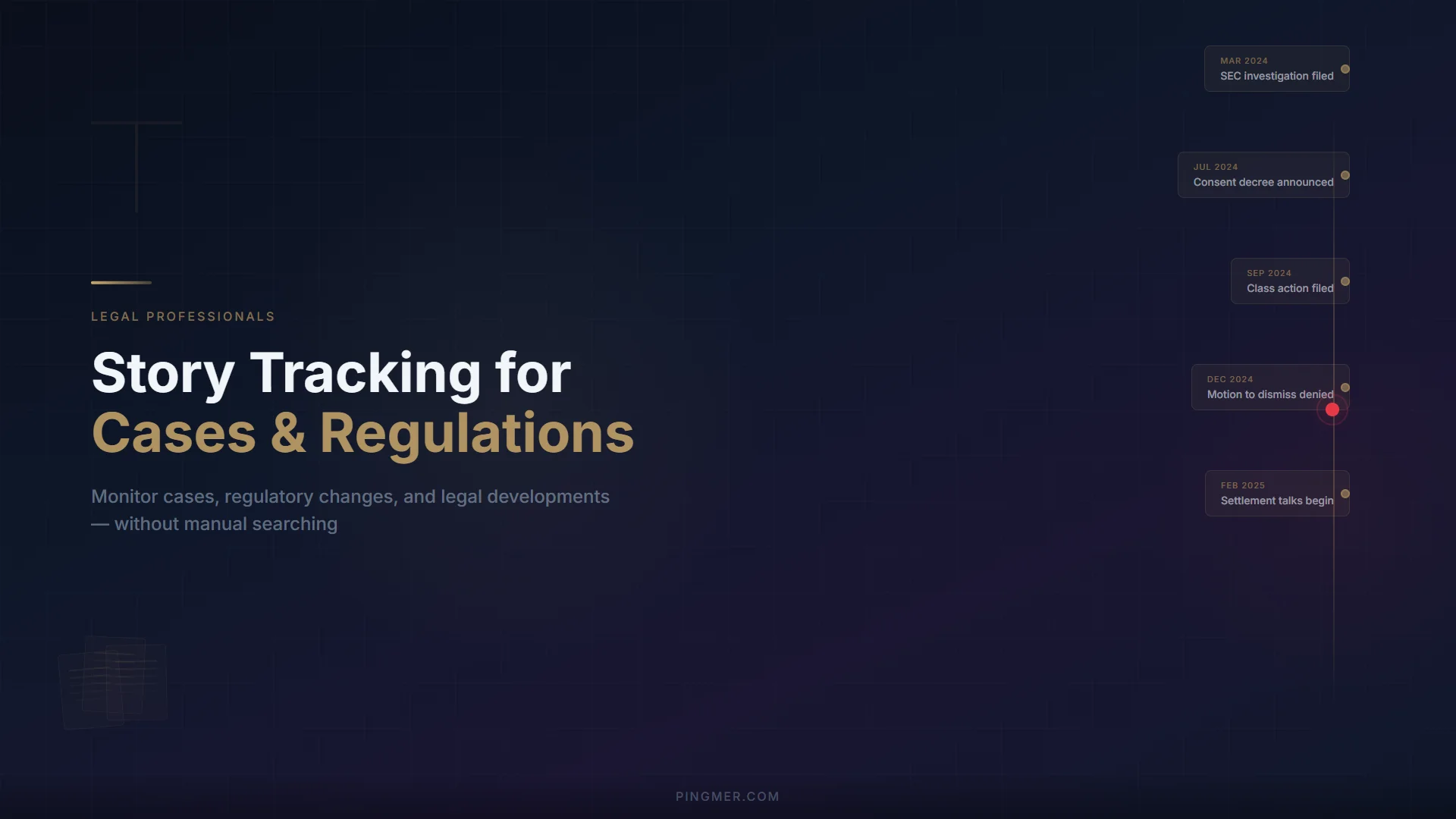
A financial analyst reads earnings reports. A marketer follows industry trends. But a lawyer needs to know that the SEC investigation filed in March led to a consent decree in July that triggered a class action in September that just had a motion to dismiss denied last week. Missing one link in that chain means giving incomplete advice.
Legal tracking has specific characteristics that make it harder than general news monitoring:
Cases move through phases. An investigation becomes charges. Charges become a trial. A trial becomes a verdict, then sentencing, then appeal. Each phase uses different language, involves different parties, and appears in different sources. A keyword alert for "SEC investigation" stops working when the story becomes "consent decree" or "civil penalty."
Timelines are long. Significant legal matters take months to years. A patent dispute might span three years of filings. A regulatory rulemaking process can take 18 months from proposed rule to final rule. You need to track developments across that entire span — not just the moments that make headlines.
Sources are fragmented. Court filings live in PACER or state court systems. Regulatory actions appear in the Federal Register or agency websites. News coverage is spread across legal publications, mainstream media, and trade press. No single source gives you the complete picture.
The stakes are high. Missing a development isn't just inconvenient — it can mean missed filing deadlines, uninformed client counsel, or regulatory surprises. When a partner asks "what's the latest on that FTC case?" the answer can't be "I'm not sure, I stopped checking."
What Legal Professionals Track
Litigation and Case Developments
The most obvious use case. You're involved in a case — or advising a client about one — and need to follow every development:
- Opposing counsel's other cases (patterns of behavior, strategy signals)
- Related cases in the same jurisdiction (precedent-setting rulings)
- Appeals and post-trial motions in concluded cases
- Class action certifications and settlements in your client's industry
The existing court case post covers how to follow a specific court case using PACER and state court systems. But for the broader question of "what's happening around this legal issue?" you need more than docket monitoring.
Regulatory Actions and Enforcement
Regulatory agencies don't announce their work in one convenient place. A single enforcement action might involve:
- The initial investigation (often reported in trade press before any official filing)
- The formal complaint or enforcement action (published on the agency's website)
- Industry reaction and analysis (legal publications)
- Settlement negotiations or consent decrees (court filings)
- Follow-on private litigation (separate court cases)
- Policy guidance changes prompted by the enforcement (Federal Register)
Tracking regulatory stories like FDA investigations or SEC enforcement requires monitoring across all of these sources simultaneously.
Track Gateway Church Defamation Lawsuit →
Legislative and Policy Changes
Bills move through committees, get amended, stall, get revived, and sometimes pass in forms unrecognizable from the original. For lawyers advising clients on compliance:
- Track bills that could affect your client's industry
- Monitor committee hearings and markup sessions
- Follow the rulemaking process after legislation passes
- Watch for state-level legislation that mirrors federal proposals
Track Texas Anti-ESG Law Ruling →
Corporate and M&A Developments
Corporate lawyers and in-house counsel track:
- M&A transactions and their regulatory approval process
- Competitor litigation and settlement patterns
- Industry consolidation trends
- Corporate governance disputes and shareholder actions
Competitive Intelligence
Law firms also track developments relevant to business development:
- Cases won or lost by competing firms
- New practice area movements by competitors
- Lateral hiring and departure patterns
- Industry sectors where litigation is increasing
How Legal Professionals Track Stories Today (And Why It Falls Short)
PACER and Court Databases
PACER gives you access to federal court filings. State systems provide local court records. These are essential but limited:
- No notifications. You have to manually check for new filings. Across multiple cases, this becomes a daily chore that's easy to skip.
- Court filings only. PACER tells you what was filed, not how the media covered it, what analysts think, or what the regulatory implications are.
- No narrative. A docket is a list of filings, not a story. Understanding what happened requires reading each filing and connecting the dots yourself.
Westlaw and LexisNexis
Legal research platforms are powerful for finding relevant cases and statutes. They're less useful for tracking ongoing stories:
- Research tools, not monitoring tools. Built for "find me the answer to this question," not "tell me when something changes."
- Expensive. Already a significant line item for most firms. Adding monitoring features (where available) increases cost.
- Document-centric. They surface documents, not narratives. You still have to piece together the story.
Google Alerts
Many lawyers set up Google Alerts for case names, client names, or legal topics. We've documented why Google Alerts is unreliable in detail, but for legal tracking specifically:
- Keyword alerts break when case terminology changes (investigation → indictment → trial)
- Alerts miss niche legal publications and trade press
- No way to distinguish a major ruling from a passing mention in an unrelated article
- No timeline or context — just isolated links
Enterprise Monitoring Tools
Some large firms use media monitoring platforms like Meltwater or LexisNexis Newsdesk. These work but come with tradeoffs:
- Enterprise pricing — custom enterprise pricing
- Built for PR teams — features like sentiment analysis, share of voice, and media contact databases that lawyers don't need
- Require configuration — setting up Boolean queries, source lists, and dashboards takes expertise and ongoing maintenance
For an Am Law 100 firm, the investment makes sense. For a solo practitioner, a mid-size firm, or an in-house legal team, it's hard to justify.
A Different Approach: Story Tracking
Story tracking works differently from keyword monitoring or document search. Instead of setting up keyword alerts or checking databases, you submit the URL of a story you want to follow. The AI reads it, understands what the story is about, and then monitors for new developments — regardless of what language the coverage uses.
For legal professionals, this means:
Phase changes don't break tracking. When a story moves from "investigation" to "indictment" to "trial," story tracking keeps following it. The AI understands the narrative, not just the words.
You get a timeline. Every development gets added to a chronological record. When a partner asks "bring me up to speed on that FTC case," you can share the timeline instead of reconstructing the story from scattered bookmarks and half-remembered articles.
Notifications on what matters. Fact-shift detection means you get notified when something genuinely changes — a new ruling, a settlement, an amendment — not every time a blog post mentions the case in passing.
Coverage across sources. The AI monitors across news outlets, legal publications, government sources, and industry press. You don't have to manually check each one.
How It Works in Practice
- You read about an SEC enforcement action against a company in your client's industry. You paste the URL into Pingmer.
- Pingmer's AI reads the article, understands it's about a specific enforcement action, and starts monitoring.
- Three weeks later, the company files a response. Pingmer detects the development and pings you.
- Two months later, a consent decree is announced. Another ping.
- A month after that, a private class action is filed citing the same facts. Ping.
- Each development appears on a timeline with sources, so you can review the full progression anytime.
You set it up once. The story tracking runs for as long as the matter is active — weeks, months, or years.
When Story Tracking Replaces Other Tools (And When It Doesn't)
Story tracking doesn't replace PACER or Westlaw. Those are research tools — you need them to find specific documents and case law. Story tracking is a monitoring layer that sits on top.
Think of it this way:
| Need | Right tool |
|---|---|
| Find a specific court filing | PACER / state court system |
| Research case law on a legal question | Westlaw / LexisNexis |
| Monitor ongoing developments in a story | Story tracking (Pingmer) |
| Track brand mentions and media coverage | Enterprise monitoring (Meltwater) |
The combination that works for most legal professionals: PACER for dockets, Westlaw for research, Pingmer for "tell me when something happens."
Frequently Asked Questions
Can story tracking replace legal research tools like Westlaw?
No. Story tracking monitors developments in ongoing stories — new rulings, regulatory actions, legislative changes. It doesn't search case law, statutes, or legal databases. Think of it as a monitoring layer that complements your research tools, not a replacement.
How is this different from setting up Google Alerts for a case name?
Google Alerts matches keywords. If the case you're tracking moves from "investigation" to "trial" to "sentencing," your keyword alert breaks at each transition. Story tracking follows the narrative itself, so terminology changes don't affect tracking. It also filters for significance — you get notified about genuine developments, not every blog post that mentions the case. For more detail, read why Google Alerts stopped working.
What kinds of legal stories can I track?
Anything that develops over time: court cases, regulatory investigations, enforcement actions, legislative proposals, M&A transactions, corporate governance disputes, policy changes, and industry-level legal trends. If it has a narrative that unfolds over weeks or months, story tracking works.
How many stories can I track at once?
Pingmer offers a free tier with 5 tracked stories and a Pro tier ($7.99/month) with 25 active stories. For a lawyer monitoring a handful of key cases and regulatory actions, the free tier may be sufficient. For broader monitoring across a practice area, Pro gives you room to track everything that matters.
Is the information from story tracking admissible or citable?
Story tracking surfaces news coverage and public reporting — not court filings or official documents. Use it as a monitoring tool to know that something happened, then go to the primary source (PACER, the Federal Register, the agency's website) for the citable document.
The Bottom Line
Legal work is inherently a tracking problem. Cases, regulations, and legislation develop over months or years. The information is public, but it's scattered across dozens of sources and changes terminology as it evolves.
Most lawyers cope with manual checking, unreliable keyword alerts, or expensive enterprise tools. Story tracking offers a middle path: AI-powered monitoring at $7.99/month that follows legal narratives through every phase, notifies you when facts shift, and keeps a timeline you can reference anytime.
The cases and regulations your clients care about don't stop developing because you got busy with other work. Now you have a way to make sure you don't miss what happens next.